
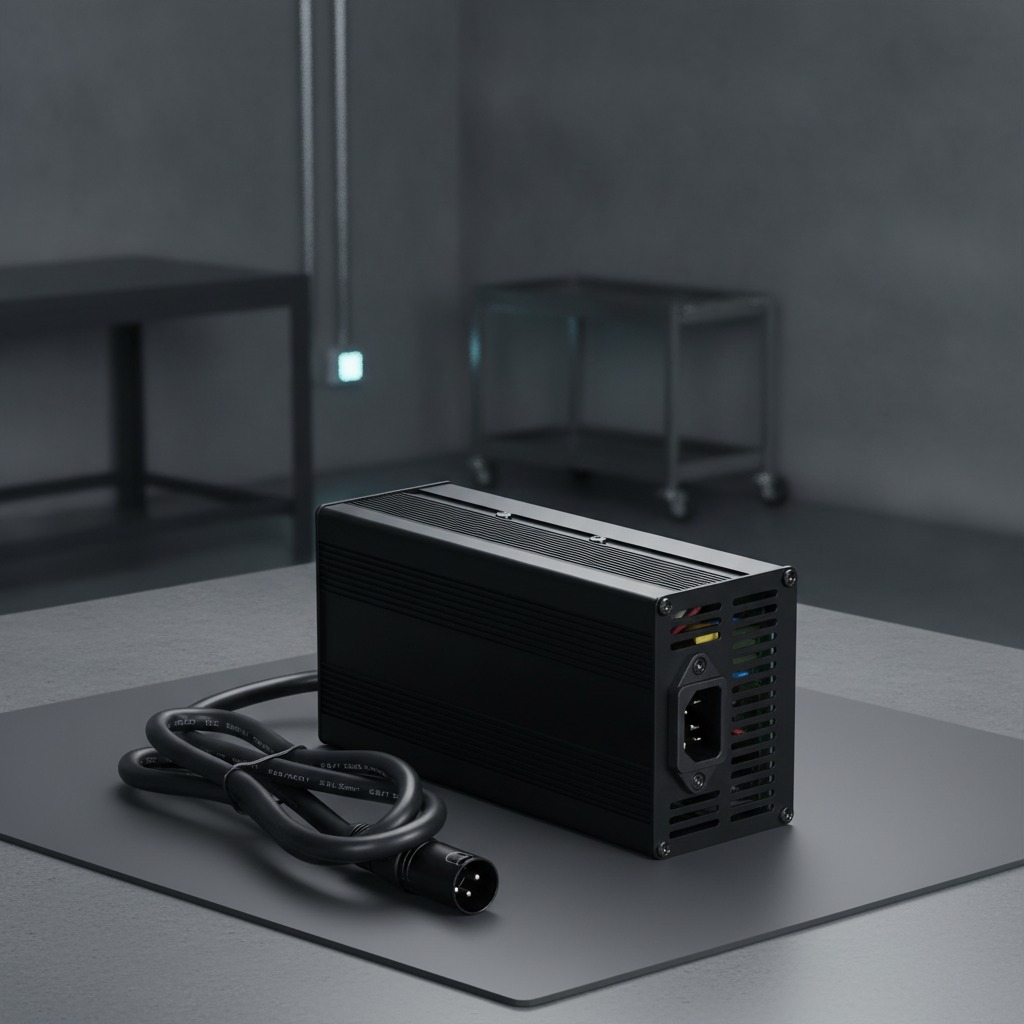
How to Choose the Right Lithium Battery Charger: A B2B Sourcing Guide
> Audience: Procurement managers, battery pack manufacturers, e-bike/scooter brands, distributors
> Reading time: 8 minutes
> Bottom line: A wrong lithium battery charger costs you returns, warranty claims and lost clients. This guide covers the 7 decisions you must get right before placing an OEM or wholesale order — battery chemistry, voltage matching, current sizing, connector type, charging profile, protection and certification.
---
Why Lithium Battery Charger Selection Goes Wrong
Most charger sourcing failures we see at Juxon are not quality problems. They are matching problems. A distributor orders a "48V charger" that turns out to be a lead-acid profile unit. A brand orders 5,000 units with the wrong XLR pinout. An OEM client specifies 54.6V output for a battery pack that actually needs 58.8V.
These mistakes share one root cause: the buyer treated the charger as a commodity part and skipped technical confirmation. In B2B, a charger is not a generic power brick — it is a chemistry-specific, connector-specific, voltage-specific component that must match the battery pack exactly.
This guide walks through the 7 decisions that determine whether your charger order succeeds or becomes after-sales burden.
---
1. Confirm Battery Chemistry First: Li-ion vs LiFePO4
Lithium is not one chemistry. The two most common in e-bikes, scooters and industrial applications are Li-ion (NMC/NCA) and LiFePO4 (LFP). They charge at different voltages and require different charging profiles.
> Key point: A "48V lithium charger" is ambiguous. For a 13S Li-ion pack you need 54.6V. For a 16S LiFePO4 pack you need 58.4V. Using the wrong one means the battery never reaches full charge — or worse, gets overcharged.
What to specify in your inquiry: State the exact chemistry (Li-ion or LiFePO4), the cell configuration (e.g. 13S), and the required charge voltage. If you only know the nominal pack voltage, say "48V Li-ion" or "48V LiFePO4" so the manufacturer can calculate the correct output.
---
2. Match Charger Voltage to Battery Voltage Exactly
The charger output voltage must equal the battery's full-charge voltage. This is not approximate — it is a hard requirement.
For example, our [42V 2A Bosch-compatible e-bike charger](https://www.juxonpower.com/product/42v-2a-bosch-compatible-ebike-charger-oval-plug) is designed for 36V Li-ion packs (10S, 42V full charge). Our [54.6V 2A 3-pin XLR charger](https://www.juxonpower.com/product/54v6-2a-3pin-xlr-battery-charger-48v-lithium) targets 48V Li-ion packs (13S, 54.6V full charge). These are not interchangeable.
> B2B sourcing rule: Never order by nominal voltage alone. Always confirm the full-charge voltage on the battery label or spec sheet, and match the charger output to it.
---
3. Size the Charging Current Correctly
Charging current affects three things: charge speed, battery lifespan and charger cost. Higher current is not always better.
Industry rule of thumb: Charge at 0.3C–0.5C for longevity, where C = battery capacity in Ah.
For e-bike batteries (5–15Ah), a 2A charger is standard for overnight charging, while a 4A or 5A charger is for fast-charge fleets or rental operations. Our [42V 2A QWIC-compatible charger](https://www.juxonpower.com/product/qwic-compatible-42v-2a-4-pin-xlr-ebike-charger) serves the 36V 5–10Ah segment; the [500W 12V-72V platform](https://www.juxonpower.com/product/500w-12v-72v-lead-acid-li-ion-lifepo4-battery-charger) can be configured up to higher currents for industrial packs.
> B2B tip: If you are supplying replacement chargers to repair shops, 2A covers 80% of e-bike demand. If you are an OEM integrating chargers into new products, size the current to your battery's 0.3C–0.5C range.
---
4. Select the Right Connector — This Is Where Most Orders Fail
Connector mismatch is the #1 cause of charger returns in B2B. Two chargers with identical 42V 2A output can be incompatible if the connector differs.
Common E-Bike and Scooter Connector Types
> Critical: Even within "XLR", the pin arrangement and polarity can differ between manufacturers. A 3-pin XLR from brand A may not work with brand B's battery port even if it physically fits.
What to send your supplier before ordering:
1. Photo of the original charger label (shows output voltage/current)
2. Photo of the charging port on the battery
3. Photo of the original connector
4. Pin/polarity diagram if available
At Juxon, we always request these before confirming a B2B order. This step alone eliminates most compatibility returns.
---
5. Charging Profile: CC/CV Is Standard, but Verify
Most lithium battery chargers use CC/CV (Constant Current / Constant Voltage) profile:
This is what our 42V, 54.6V and 67.2V chargers all use. It is the correct profile for both Li-ion and LiFePO4 — but the CV voltage differs (see Section 1).
For lead-acid batteries, the profile is different (multi-stage: bulk/absorption/float). Do not use a lead-acid charger on a lithium pack, even if the voltage matches. The float stage can keep pushing current into a full lithium cell, causing damage.
> B2B verification: Ask the supplier to confirm the charging profile in writing. "CC/CV with no float stage" is what you want for lithium.
---
6. Protection Functions: Non-Negotiable for B2B
A B2B charger must have these protections to pass QC and avoid field failures:
All Juxon chargers include OVP/OCP/SCP/OTP as standard. The [500W platform](https://www.juxonpower.com/product/500w-12v-72v-lead-acid-li-ion-lifepo4-battery-charger) adds reverse polarity protection, which is essential for OEM equipment integration where installer error is possible.
> For OEM/ODM projects: Specify protection requirements in the technical agreement. If the charger integrates into equipment that may have user-swappable batteries, reverse polarity protection is mandatory.
---
7. Certification: Match to Your Target Market
Certification is a market-access requirement, not optional. Selling uncertified chargers into regulated markets risks customs seizure and liability.
Our chargers carry CE/FCC/RoHS/UKCA as standard, with UL and GS available as options. For Japan-specific projects, PSE certification can be arranged — discuss this in your inquiry if JP is your target market.
> B2B sourcing tip: If you distribute to multiple countries, order chargers with the broadest cert set (CE + RoHS + UKCA + FCC minimum) and request test reports, not just a certificate copy. Customs in DE, FR and NL increasingly ask for test reports.
---
Quick Checklist: What to Send Your Charger Supplier
Before requesting a quote, prepare this information to get an accurate quote fast:
---
FAQ
Q1: Can I use one charger model for both Li-ion and LiFePO4 batteries?
No, not if the voltages differ. A 48V Li-ion pack needs 54.6V; a 48V LiFePO4 pack needs 58.4V. However, configurable platforms like our 500W charger can be set to different voltages at the factory for different chemistries — specify this in your OEM order.
Q2: What happens if I use a lead-acid charger on a lithium battery?
The float stage in lead-acid chargers can overcharge lithium cells, causing capacity loss, swelling or fire risk. Always use a CC/CV charger without float for lithium.
Q3: How do I know if a 42V charger is right for my 36V e-bike battery?
42V is the correct full-charge voltage for a 10S Li-ion pack (nominal 36V). Verify your battery label says "36V Li-ion" and the original charger output is 42V. Also confirm the connector matches.
Q4: What is the difference between 2A and 4A chargers for the same 42V output?
Voltage must match the battery; current determines charge speed. A 2A charger takes roughly twice as long as a 4A charger for the same battery. Choose 2A for standard overnight charging, 4A for fleet/rental fast turnaround.
Q5: Do your chargers support OEM labeling and custom packaging?
Yes. We offer full OEM/ODM including logo printing, custom labels, retail packaging, cable length, AC plug and connector customization. Minimum order quantities apply — [contact us for details](https://www.juxonpower.com/contact).
---
Ready to Source the Right Lithium Battery Charger?
Getting the spec right before you order saves weeks of returns and after-sales issues. Send us your battery spec, connector photo and target market — we will confirm the correct charger configuration and provide a quote within 24 hours.
Sample orders available for qualified B2B projects. 24-hour quote response. Factory-direct pricing from Dongguan, China.
---
*Juxon Technology — 30+ years manufacturing experience · 50,000 m² factory · 4,000+ charger models · CE/RoHS/UKCA/UL certified*