
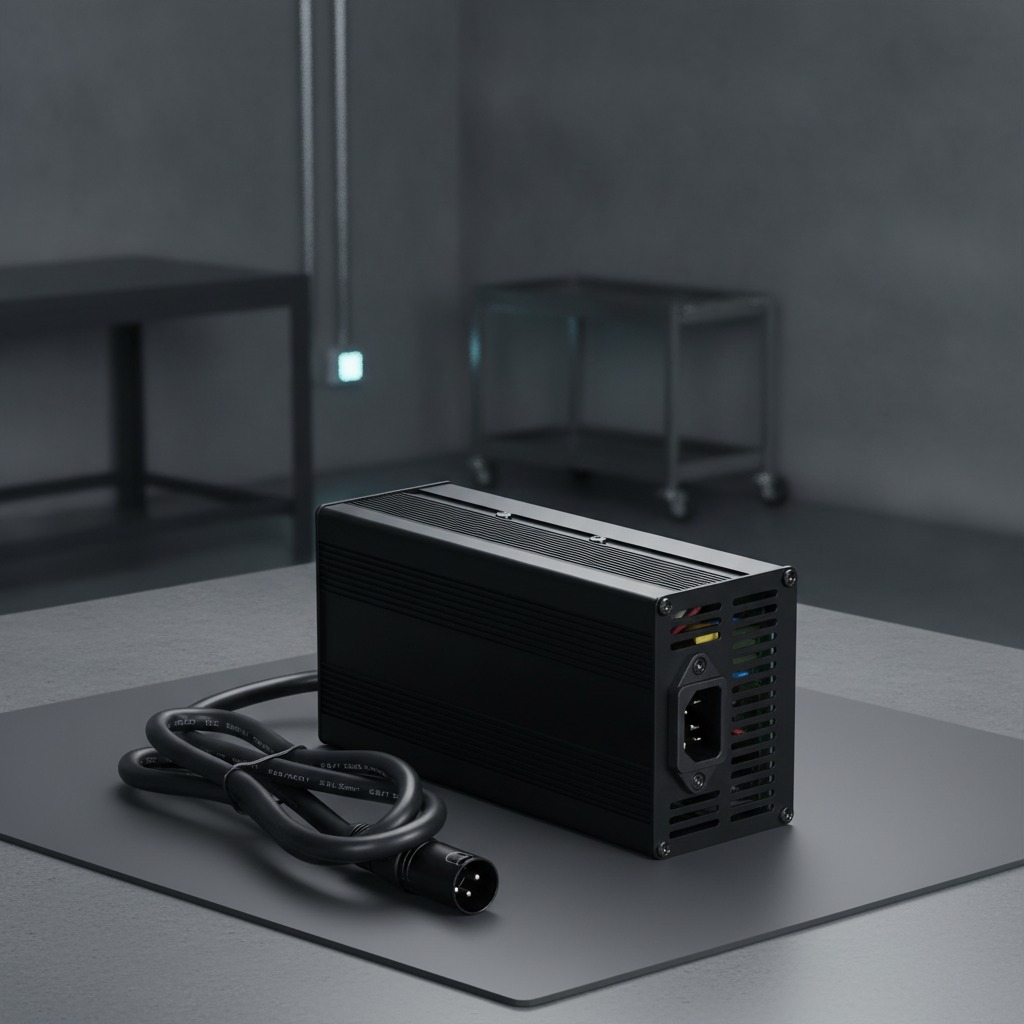
Introduction: Specialty battery chargers for commercial vehicles
Beyond consumer e-bikes, battery chargers power a wide range of commercial and industrial vehicles: golf carts moving players across courses, forklifts handling pallets in warehouses, and marine craft operating in salt-water environments. Each application places unique demands on voltage, current, environmental protection, and connector design. This guide explains how OEM buyers should specify chargers for these three high-volume segments.
1. Golf cart battery chargers: 36V and 48V systems
Golf carts traditionally used 36V lead-acid banks, but the market is rapidly shifting to 48V lithium-ion and LiFePO4 packs for lighter weight, longer cycle life, and faster charging. A 48V lithium-ion cart typically needs a 54.6V charger, while a 48V LiFePO4 pack requires a 58.4V or 58.8V end-of-charge voltage. Buyers should also consider charge current: 2A to 5A is common, balancing charge time against battery longevity.
Because golf carts are used outdoors, at least IP54 protection is recommended; IP65 is preferable for courses with frequent rain or irrigation. On-board chargers are becoming popular, so the housing must survive vibration, dust, and occasional water exposure. Juxon offers OEM chargers with custom voltage mapping, branded housings, and AC plug options for the US, Europe, and Japan.
2. Forklift battery chargers: 24V, 48V, and 80V industrial power
Electric forklifts are the workhorses of warehousing and logistics. Common battery voltages include 24V for smaller walkies, 48V for reach trucks and pallet jacks, and 80V for heavy-duty counterbalance trucks. Lithium-ion conversions are replacing lead-acid because opportunity charging reduces downtime. Forklift chargers therefore need robust output current, smart charging profiles, and CAN-bus communication in some cases.
Key specifications for forklift chargers include high efficiency, active cooling, and heavy-duty cabling. DIN or Anderson SB/SY connectors are common. The charger should also include OVP, OCP, SCP, OTP, and reverse polarity protection. Juxon can configure chargers from 200W to 2000W with connector, cable, and firmware customization for OEM forklift brands.
3. Marine battery chargers: corrosion, waterproofing, and safety
Marine environments combine salt air, humidity, vibration, and temperature swings, making charger reliability critical. Marine chargers typically operate at 12V, 24V, or 48V and must be fully sealed. IP67 housing, conformal-coated circuit boards, and stainless hardware are standard expectations for salt-water use.
Multi-bank chargers are popular in boats, allowing simultaneous charging of house and starter batteries. Isolated outputs prevent cross-bank interference. For OEM boat builders, compact dimensions and shore-power compatibility are important. Juxon supplies waterproof chargers from 60W to 1000W with IP65/IP67 options and marine-grade connectors.
4. IP rating and environmental sealing
Application chargers often face tougher conditions than indoor consumer chargers. Recommended minimums:
- IP20–IP30: Indoor warehouse forklifts only
- IP54: Covered golf cart storage and general industrial use
- IP65/IP67: Outdoor golf carts, marine decks, wash-down environments
Always validate that the manufacturer performs real ingress testing, not just claims on the label.
5. OEM customization for application chargers
Branded commercial vehicles usually need chargers that match their brand identity and technical standards. Common OEM requests include:
- Custom output voltage and current curves
- Logo printing or laser engraving on housing
- Specific DC connectors (Anderson, DIN, XLR, marine-grade)
- AC plug types for target countries
- Cable length and strain-relief design
- LED status indicators or CAN/RS485 communication
Juxon supports OEM projects from 500 units with rapid sampling and flexible MOQ scaling.
FAQ
Can one charger handle both golf cart and forklift batteries? Only if the voltage and chemistry match exactly. It is safer to specify a charger per battery configuration.
Is a marine charger different from a regular waterproof charger? Marine chargers usually require additional corrosion resistance, isolated banks, and vibration testing beyond standard IP ratings.
What is the typical MOQ for an OEM forklift charger? Juxon accepts OEM projects from 500 units for label/branding work and 1,000+ for fully custom housing or firmware.
How long is the lead time? Standard application chargers ship in 15–30 days; custom OEM projects take 30–45 days depending on certification requirements.