
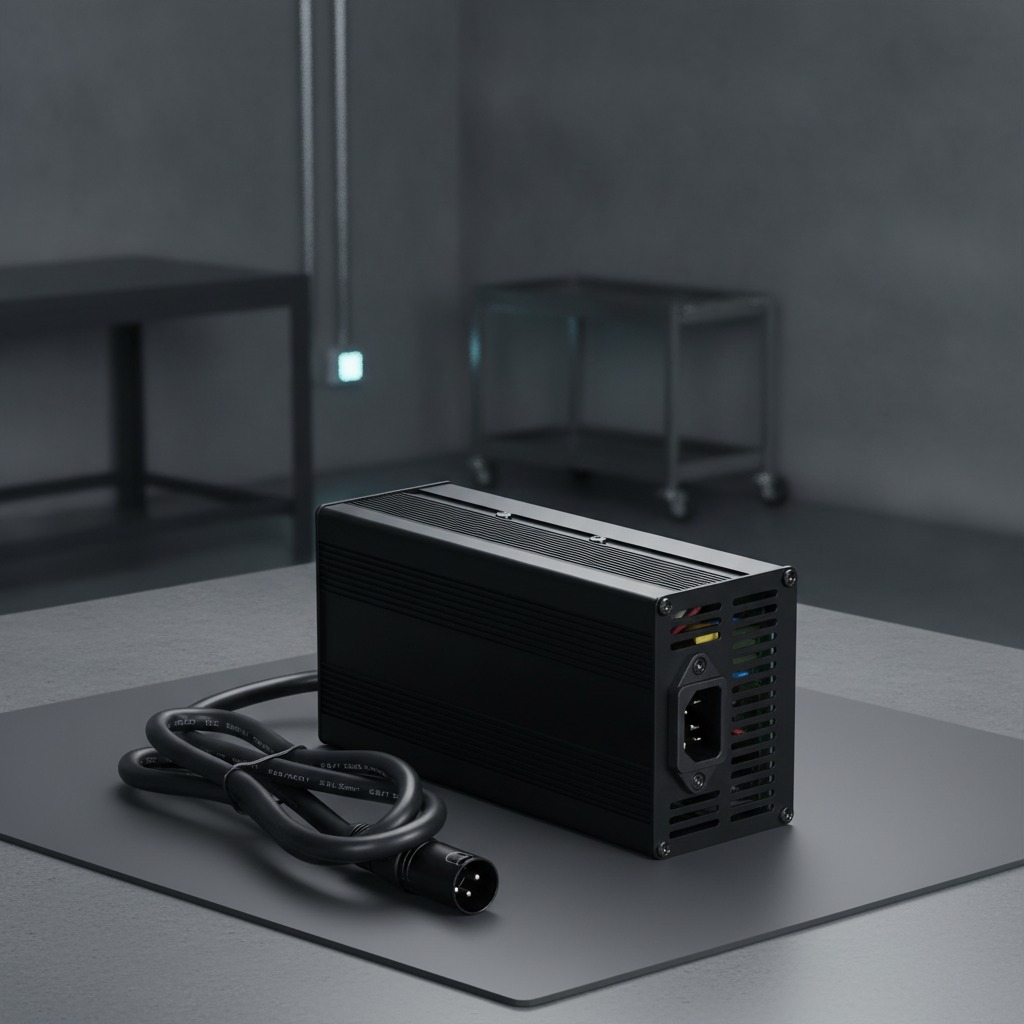
Golf Cart Battery Charger Buying Guide: 36V/48V/72V OEM Sourcing
Golf carts represent a significant and growing market for battery chargers. This guide covers everything OEM buyers need to know about sourcing golf cart chargers, from voltage matching to connector selection and certification requirements.
1. Golf Cart Battery Systems Overview
Most golf carts use one of three voltage systems:
| System Voltage | Charge Voltage | Typical Battery Config | Common Applications |
|---|---|---|---|
| 36V | 42V-44V | 6x 6V lead-acid or 10S Li-ion | Standard golf carts, EZGO, Club Car |
| 48V | 54.6V-58V | 4x 12V or 13S/14S Li-ion | Modern golf carts, Yamaha Drive2 |
| 72V | 84V | 20S Li-ion | Heavy-duty, industrial, utility carts |
2. Lead-Acid vs LiFePO4 Golf Cart Chargers
Lead-Acid Golf Cart Chargers
- Charge voltage: 2.4V-2.45V per cell (higher than float voltage)
- Algorithm: Multi-stage (bulk → absorption → float)
- Key feature: Automatic equalization charge to prevent stratification
- Charge current: 10-25A typical
- Connector: Often Anderson SB50/SB175 or custom round plug
LiFePO4 Golf Cart Chargers
- Charge voltage: 3.65V per cell (14.6V for 12V system, 43.8V for 36V, 58.4V for 48V)
- Algorithm: CC-CV with BMS communication
- Key feature: Must communicate with BMS via CAN bus or RS485
- Charge current: 15-50A typical (LiFePO4 accepts higher current)
- Advantage: 3-5x longer cycle life, 60% lighter weight
3. Key Specifications to Specify When Sourcing
Voltage and Current
- Must match battery system exactly (36V/48V/72V)
- Charge voltage must match battery chemistry (lead-acid vs LiFePO4)
- Current rating: 15-25A for standard carts, 25-50A for fast charging
Connector Types
- Anderson SB50/SB175: Most common for lead-acid golf carts
- Round 3-pin (Lester): Used by Club Car and some Yamaha models
- Custom OEM connector: For proprietary charging ports
- CAN bus J1939: For smart LiFePO4 systems
Environmental Protection
- Golf cart chargers are often exposed to moisture and dust
- Minimum IP54 rating for onboard chargers
- IP67 recommended for outdoor/portable chargers
- Operating temperature: -20°C to +50°C
Smart Features
- LED status indicator (charging/full/fault)
- Automatic shutoff when fully charged
- Temperature sensor for safe charging
- Optional: Bluetooth/WiFi for remote monitoring
- OLED display for voltage/current/SOC (premium models)
4. Certification Requirements by Market
| Market | Required Certifications | Notes |
|---|---|---|
| USA | UL 1564, FCC Part 15 | UL 1564 is specific to industrial battery chargers |
| EU | CE (LVD 2014/35/EU, EMC 2014/30/EU), RoHS | EN 60335-2-29 for charger safety |
| Japan | PSE | Required for electrical safety |
| Global | CB scheme, IEC 60335-2-29 | Facilitates multi-market approval |
5. OEM Sourcing Checklist
- Define specifications: Voltage, current, chemistry, connector, IP rating
- Specify certifications: Match to your target markets
- Request samples: Test with actual golf cart batteries
- Verify BOM: Ensure quality components (TI/MPS controller ICs, Rubycon capacitors)
- Quality audit: ISO 9001 factory, QC test reports, aging test data
- MOQ negotiation: Standard 500-1000 units for OEM, lower for ODM modifications
- Lead time: 20-30 days for mass production, 7-15 days for samples
- Warranty: Minimum 18 months, ideally 24 months
6. Common Golf Cart Charger Problems and Solutions
Charger won't turn on
Check: AC input voltage, fuse, DC output connector contact, battery voltage (some chargers won't start if battery is below minimum threshold).
Charger shuts off prematurely
Likely cause: Temperature sensor triggering, or BMS cutting off charge. Verify charger temperature compensation settings match battery specs.
Battery not reaching full charge
Check: Charge voltage setting, connector resistance, battery cell balance. For LiFePO4, verify BMS is not limiting voltage.
FAQ
Can I use a 48V charger on a 36V golf cart?
No. Using a higher voltage charger will damage the battery and create a safety hazard. Always match charger voltage to battery system voltage.
How long does it take to charge a golf cart battery?
A typical 48V 100Ah golf cart battery with a 48V 18A charger takes approximately 7-8 hours from empty to full. LiFePO4 batteries charge faster due to higher efficiency.
Can I convert my lead-acid golf cart to LiFePO4?
Yes, but you must replace the charger with a LiFePO4-specific charger. Lead-acid chargers have different voltage profiles and lack BMS communication, which can damage LiFePO4 batteries.
What is the difference between onboard and offboard golf cart chargers?
Onboard chargers are mounted inside the cart and connected to AC power via a cord. Offboard chargers are external units that connect to the cart via a DC plug. Onboard chargers are more convenient but add weight; offboard chargers are more powerful and durable.
Looking for a reliable golf cart charger manufacturer? Contact Juxon Power for OEM/ODM solutions with 36V/48V/72V chargers, UL/CE certifications, and custom connector options.