
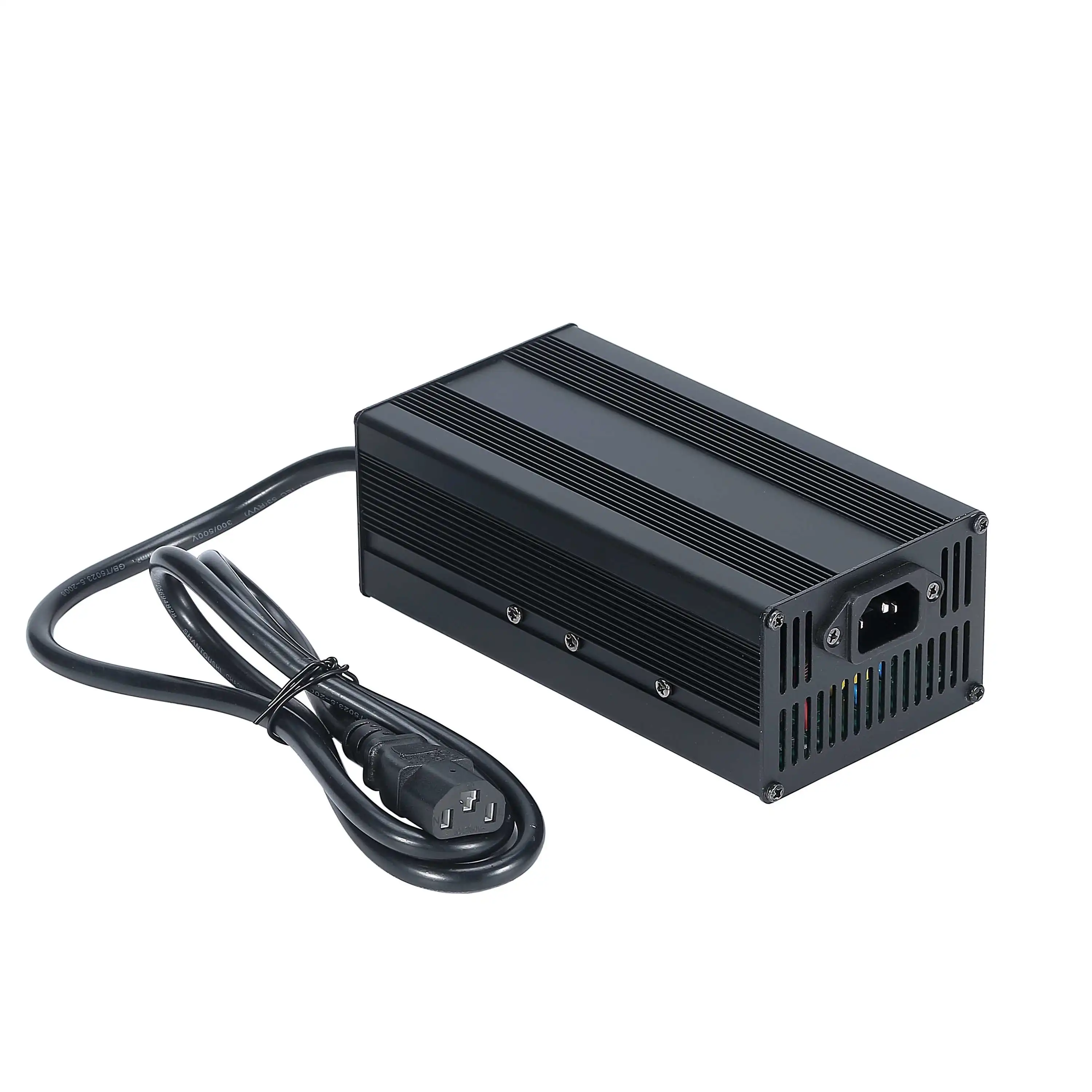
The short answer: you cannot use a lead-acid charger on a lithium battery pack, and vice versa. Although both technologies store electrical energy, their charging curves, voltage thresholds, safety requirements, and lifecycles are fundamentally different. For OEM buyers, specifying the wrong charger can void battery warranties, shorten product life, and create safety liabilities.
1. Chemistry Basics: Lead-Acid vs Lithium-Ion
Lead-acid batteries use lead plates immersed in a liquid electrolyte. They are inexpensive, tolerant of abuse, and widely used in industrial vehicles, UPS systems, and solar storage. Their downsides are high weight, low energy density, and a limited cycle life of 300–500 cycles.
Lithium-ion (NMC, LCO) and lithium iron phosphate (LiFePO4) batteries use a lithium salt electrolyte. They are lighter, more compact, and deliver 1,000–5,000 cycles depending on chemistry. Their nominal cell voltage is higher (3.2–3.7 V) than lead-acid (2.0 V per cell).
2. Charging Profiles: CC/CV vs IUoU
Lead-acid chargers typically follow an IUoU profile: constant current, constant voltage, absorption, and then a float stage. The float stage keeps the battery at full charge without overcharging.
Lithium chargers use a CC/CV (Constant Current / Constant Voltage) profile and terminate when the current drops to a cutoff level. There is no float stage. Applying a lead-acid float voltage to a lithium pack causes overcharge, cell swelling, and potential thermal runaway.
Juxon’s programmable 12 V–72 V charger supports both lead-acid and lithium profiles by OEM configuration, so you can cover both battery types with one hardware platform.
3. Voltage and End-of-Charge Thresholds
Voltage matching is non-negotiable. A 12 V lead-acid battery charges to about 14.4 V. An 11.1 V lithium-ion 3S pack charges to 12.6 V. A 12.8 V LiFePO4 4S pack charges to 14.6 V. Using the wrong threshold dramatically reduces cycle life and can damage cells.
For 48 V e-bike fleets, our 54.6 V 2A XLR charger is precisely calibrated for 13S lithium-ion packs. We also supply custom voltage variants for B2B volume orders.
4. Efficiency, Weight, and Total Cost of Ownership
Lead-acid charging efficiency is around 75–80%. Lithium charging efficiency reaches 90–95%. That difference lowers electricity consumption, reduces heat sinking, and allows smaller enclosures.
Cycle life is equally important. Lead-acid delivers 300–500 cycles; lithium-ion typically delivers 1,000–2,000 cycles; LiFePO4 can exceed 2,000–5,000 cycles. Over the product lifetime, lithium often becomes the lower-cost option despite the higher upfront battery price.
5. Safety: BMS, Protection, and Certifications
Lithium batteries require a BMS (Battery Management System) to balance cells and disconnect during overvoltage, undervoltage, over-temperature, or short-circuit events. The charger must work safely with the BMS. Lead-acid is more forgiving but still requires overcharge and sulfation protection.
Juxon chargers carry CE, RoHS, and UL certifications and include built-in OVP, OCP, OTP, and short-circuit protection. Our 42 V 2A Bosch-compatible charger, for example, includes connector detection and automatic shutdown.
6. OEM Sourcing Checklist
Before ordering a charger, confirm the following with your supplier:
- Battery chemistry (lead-acid, NMC, LFP, LCO)
- Nominal voltage and capacity in Ah
- Connector type, polarity, and pinout
- Required labeling, LED status, or communication protocol
- Target production volume and MOQ
A poorly specified charger can create costly warranty claims. We recommend ordering validation samples and running compatibility tests before volume production.
7. FAQ
Can I charge a lithium battery with a lead-acid charger?
No. The float voltage and charging profile of a lead-acid charger are incompatible with lithium cells and can cause permanent damage or safety issues.
What certifications are required for Europe?
CE marking is mandatory. RoHS is recommended for hazardous substance restriction. UL or cUL is often required for North America.
What is the typical MOQ for a custom charger?
Juxon’s standard MOQ is 500 units for customized chargers. Lower volumes are available for standard models.
How fast can I receive a quote?
We provide detailed quotes within 24 business hours after receiving full specifications.
Do you provide samples?
Yes, validation samples are available for confirmed OEM projects. Contact us for sample conditions.
Conclusion
Choosing between a lead-acid charger and a lithium charger involves more than matching voltage. The charging profile, safety architecture, efficiency, and lifecycle all affect the final product. For brands and distributors looking for a reliable partner, Juxon offers programmable, certified, and customizable chargers for both battery chemistries.
Get a free 24-hour quote and receive a technical recommendation matched to your battery specifications.